
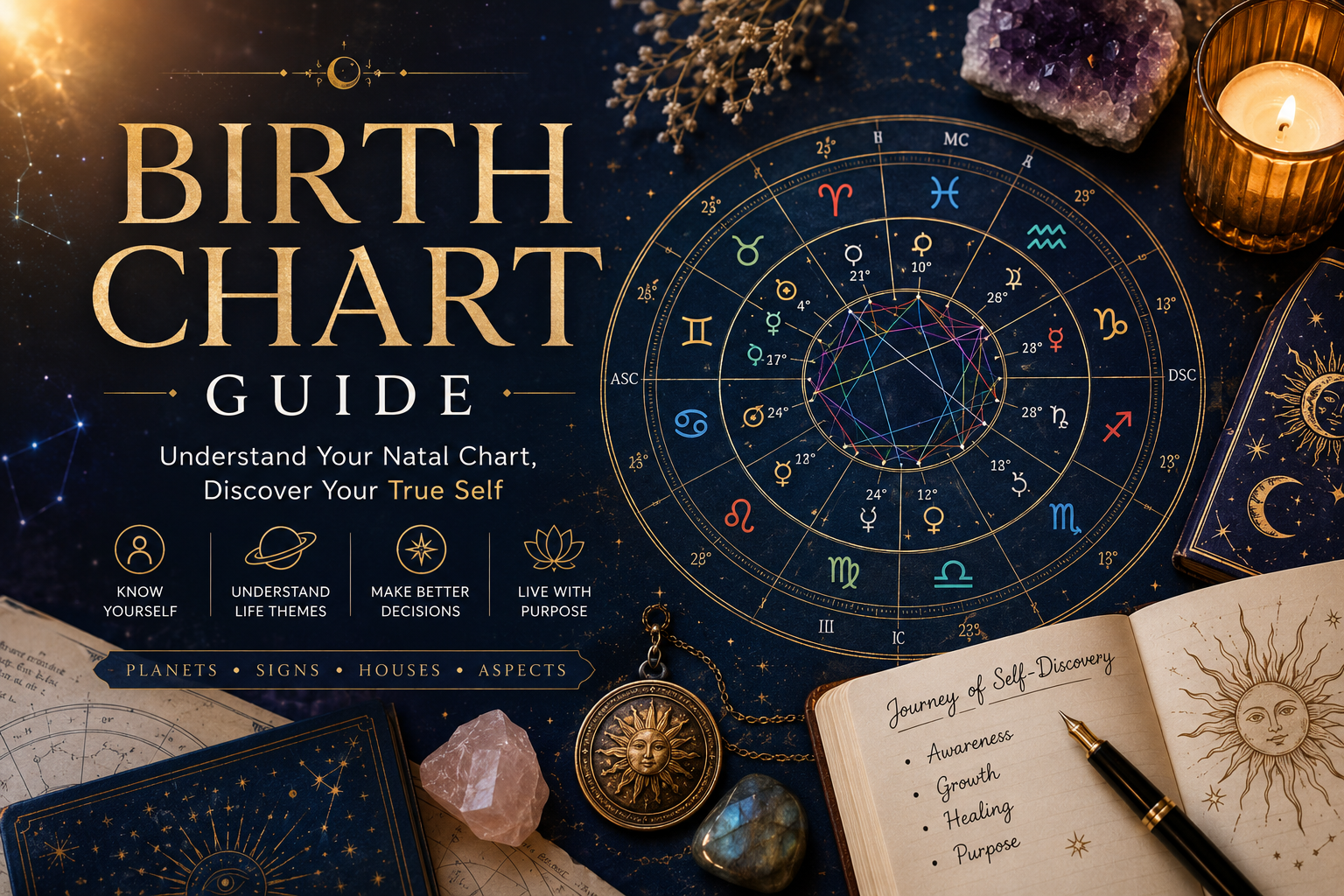
A Complete Beginner’s Guide to Understanding Your Natal Chart


Learn how to read your birth chart, understand the meanings of planets, zodiac signs, houses, and aspects, and discover how astrology interprets personality and life themes.
Table of Contents
- What Is a Birth Chart?
- What Information Is Needed?
- The Three Pillars of Astrology
- The 10 Planets Explained
- The 12 Zodiac Signs
- The 12 Astrological Houses
- Understanding Aspects
- Step-by-Step Guide to Reading Your Birth Chart
- Frequently Asked Questions
- Final Thoughts
What Is a Birth Chart?
A birth chart (also called a natal chart) is a map of the sky at the exact moment and location of your birth. In astrology, practitioners interpret the positions of the Sun, Moon, planets, zodiac signs, and astrological houses to explore themes related to personality, strengths, challenges, and life experiences.
Astrology is a belief system and symbolic practice rather than a scientifically validated method of predicting personality or future events. Many people enjoy birth chart readings as a tool for self-reflection and personal growth.
What Information Is Needed?
To create an accurate birth chart, you typically need:
- 📅 Date of Birth
- 🕒 Exact Time of Birth
- 📍 Place of Birth
The more accurate the birth time, the more precise the chart—especially for the Ascendant (Rising Sign) and the house placements.
The Three Pillars of Astrology
Many beginners start with the “Big Three.”
| Placement | Represents |
|---|---|
| ☀️ Sun Sign | Identity, core personality, vitality |
| 🌙 Moon Sign | Emotions, instincts, inner world |
| ⬆️ Rising Sign (Ascendant) | First impressions, outward style, approach to life |
Together, these placements form the foundation of many astrological interpretations.
The 10 Planets and Their Meanings


☀️ Sun
Represents your core identity, life purpose, and self-expression.
🌙 Moon
Represents emotions, intuition, comfort, and subconscious patterns.
☿ Mercury
Communication, thinking, learning, and decision-making.
♀ Venus
Love, relationships, beauty, values, and creativity.
♂ Mars
Action, ambition, courage, motivation, and energy.
♃ Jupiter
Growth, optimism, learning, abundance, and expansion.
♄ Saturn
Responsibility, discipline, structure, patience, and life lessons.
♅ Uranus
Innovation, change, originality, and independence.
♆ Neptune
Dreams, imagination, spirituality, and inspiration.
♇ Pluto
Transformation, renewal, power, and deep personal change.
The 12 Zodiac Signs


| Zodiac Sign | Element | Traditional Themes |
|---|---|---|
| Aries | Fire | Initiative, courage |
| Taurus | Earth | Stability, patience |
| Gemini | Air | Curiosity, communication |
| Cancer | Water | Nurturing, sensitivity |
| Leo | Fire | Creativity, confidence |
| Virgo | Earth | Practicality, organization |
| Libra | Air | Harmony, relationships |
| Scorpio | Water | Depth, transformation |
| Sagittarius | Fire | Adventure, learning |
| Capricorn | Earth | Discipline, ambition |
| Aquarius | Air | Innovation, independence |
| Pisces | Water | Compassion, imagination |
The 12 Astrological Houses
The houses describe areas of life where planetary energies are interpreted.
| House | Life Area |
|---|---|
| 1st | Self, appearance, identity |
| 2nd | Finances, possessions, values |
| 3rd | Communication, siblings, learning |
| 4th | Home, family, roots |
| 5th | Creativity, romance, children |
| 6th | Health, work, routines |
| 7th | Partnerships, marriage |
| 8th | Transformation, shared resources |
| 9th | Higher learning, travel, philosophy |
| 10th | Career, reputation, public life |
| 11th | Friends, community, aspirations |
| 12th | Spirituality, reflection, subconscious |
Understanding Aspects
Aspects describe the angular relationships between planets and are interpreted as showing how different parts of the chart interact.
Common aspects include:
- Conjunction (0°): Strong blending of energies.
- Sextile (60°): Opportunities and cooperation.
- Square (90°): Challenges that may encourage growth.
- Trine (120°): Ease and natural flow.
- Opposition (180°): Balance, tension, or complementary qualities.
Interpretations vary depending on the planets and signs involved.
How to Read Your Birth Chart Step by Step
Step 1: Find Your Sun Sign
Understand your core personality traits.
Step 2: Explore Your Moon Sign
Learn about your emotional responses and inner needs.
Step 3: Identify Your Rising Sign
See how you present yourself and begin new experiences.
Step 4: Look at the Planets
Notice which signs and houses each planet occupies.
Ask questions like:
- How does Venus express relationships?
- Where does Mars direct energy?
- What life area does Jupiter emphasize?
Step 5: Study the Houses
Observe where your planets are located.
For example:
- Venus in the 7th House may emphasize relationships.
- Jupiter in the 10th House may highlight career growth themes.
These are examples of common astrological interpretations rather than factual predictions.
Step 6: Notice Major Aspects
Look for conjunctions, trines, squares, oppositions, and sextiles to understand how different chart elements interact.
Birth Chart Reading Tips for Beginners
✅ Learn one placement at a time.
✅ Start with your Sun, Moon, and Rising signs.
✅ Keep notes as you learn.
✅ Compare multiple reputable astrology resources.
✅ Treat interpretations as tools for reflection rather than certainty.
Common Birth Chart Misconceptions
❌ Your Sun sign tells your entire story.
Reality: A full chart includes planets, houses, aspects, and more.
❌ Astrology predicts your future with certainty.
Reality: Astrological interpretations vary and are not scientifically proven forecasts.
❌ A “difficult” placement means a bad life.
Reality: Many astrologers see challenging placements as opportunities for learning and growth.
Frequently Asked Questions
Is my birth time important?
Yes. An accurate birth time is especially important for calculating the Ascendant (Rising Sign) and house placements.
Can I read my own birth chart?
Absolutely. Many beginners start by learning the meanings of the Big Three, then gradually explore planets, houses, and aspects.
Is astrology scientifically proven?
Astrology is not supported by scientific evidence as a method for predicting personality or future events. Many people use it as a symbolic framework for self-reflection and personal exploration.
What’s the difference between a birth chart and a horoscope?
A birth chart is based on the exact date, time, and place of birth. A horoscope is typically a general astrological forecast for a sign or chart over a period of time.
Final Thoughts
A birth chart is a rich symbolic map that many people find helpful for exploring personality, values, motivations, and life themes. By understanding your Sun, Moon, Rising Sign, planets, houses, and aspects, you can build a deeper appreciation for astrology as a reflective practice.
Whether you’re just beginning or expanding your knowledge, take your time and enjoy the learning process. Astrology is most valuable when approached with curiosity, critical thinking, and an open mind.